
Pyrite: fool’s gold that earns its place
Two bracelets in the shop are strung with pyrite — The Encore and The Night Watch — both beaded, both finished in sterling and made to order in Nashville. Below: what pyrite actually is, why it is the one stone in the shop I will ask you to keep dry, and the two pieces themselves.
What pyrite actually is
Pyrite is iron sulfide, and it grows in cubes so square they look machined rather than grown. Nature does not usually hand you right angles. Pyrite does it routinely.
It sits at 6 to 6.5 on the Mohs scale, which is harder than glass and harder than most people expect from something that looks like metal.
It is also dense. A pyrite bead weighs noticeably more than a stone bead the same size, and that weight is most of why these bracelets sit on the wrist the way they do rather than riding up.
Why they call it fool’s gold
Because the color is right and the shine is right, and in low light across a pan of gravel that is enough to fool a tired man.
The giveaways are hardness and heft. Gold is soft enough to dent with a pin; pyrite will not dent, it will chip. Gold drawn across unglazed porcelain leaves a yellow streak, pyrite leaves a greenish-black one.
And gold is nearly three times the weight of pyrite, which sounds academic until you have held both.
Strung with pyrite
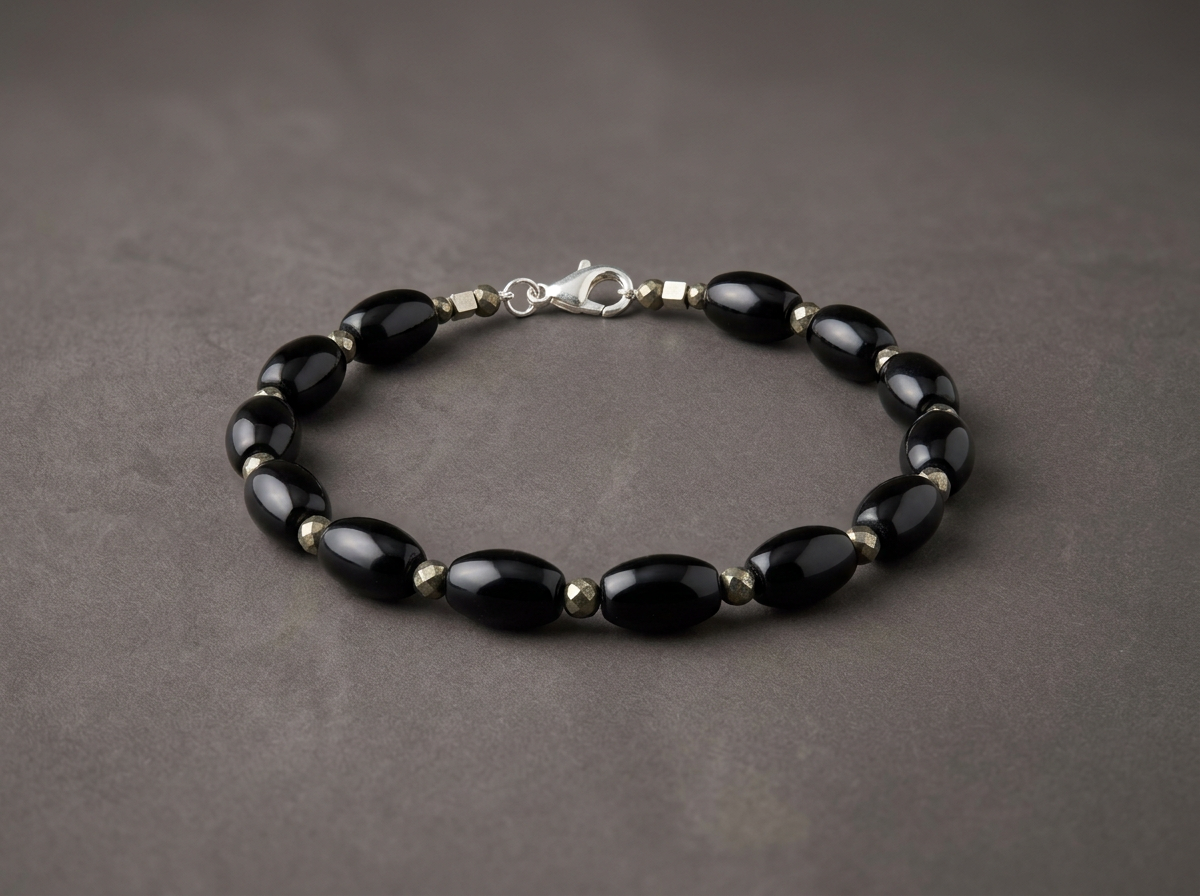
Two bracelets, each one strung to order.
How I use it, and why it is always a bead
Pyrite is brittle. It is hard enough to resist a scratch and still happy to fracture if you lean on it, which rules it out of the shield rings and the statement settings. On a hand that is actually being used, a pyrite cabochon is a question of when rather than if.
As a bead it does the one thing nothing else in the shop does. It throws a hard metallic glint next to a matte stone, and it does it without adding another color.
With lapis that pairing is not arbitrary. Good lapis already has pyrite in it, scattered through the blue in flecks - that is one of the ways you tell real lapis from dyed. Putting pyrite beads next to it takes what is already inside the stone and says it out loud.
Against onyx it is the only light in the piece. Black, metal, black, metal. Nothing else going on.
Looking after it
This is the one thing in the shop I will ask you to keep dry.
Pyrite is iron sulfide, and iron sulfide and water are a slow argument that pyrite loses. Given enough moisture and air it dulls, then blooms a rusty film, and in the worst cases it starts to break down from the inside.
So: a dry soft cloth, and that is the whole routine. No water, no soap soak, no ultrasonic cleaner, no steam. Off before the shower, the pool and the gym. Store it somewhere dry rather than in a humid bathroom.
If it ever needs re-stringing, bring it back. That is free, forever, for anything I have made.
Questions I get about Pyrite
Will it rust?
Given enough moisture, yes - it is iron sulfide and that is simply what iron sulfide does. Keep it dry and wipe it down and it will long outlast whatever trend sold it to you.
Is it magnetic?
No. That is one of the quick ways to separate pyrite from magnetite, which looks similar and will jump to a magnet.
Why pyrite with lapis?
Because good lapis already has pyrite in it. The pairing puts the flecks on the outside of the stone instead of locked in the blue.
Can you make a pyrite ring?
I would rather talk you out of it. Pyrite is brittle, and a ring is the harshest place in jewelry to be brittle. I would rather say no than sell you something that chips in a year.
Some nights don't end when the house lights come up.
Deep royal-blue Lapis Lazuli runs the length of this one, broken up by faceted Pyrite beads that catch the light like one last round of stage light before the crowd lets you go. It's the piece for the night that isn't ready to be over yet.